Eclipse Ring Chapter II. Black Mother of Pearl. *Limited*
IMPORTANT: This jewel is limited and we are unsure if they'll be available again in the future. We recommend Express Shipping with signature required upon delivery to best ensure it arrives safely in your hands.
PLEASE NOTE : You must either leave your ring size in the notes section while going through the check out process or reach out to us via email after placing your order to confirm your ring size. We cannot begin creating your ring until your ring size is confirmed.
Because these stones are very limited, we are not able to accommodate any requests for specific stone color preferences.
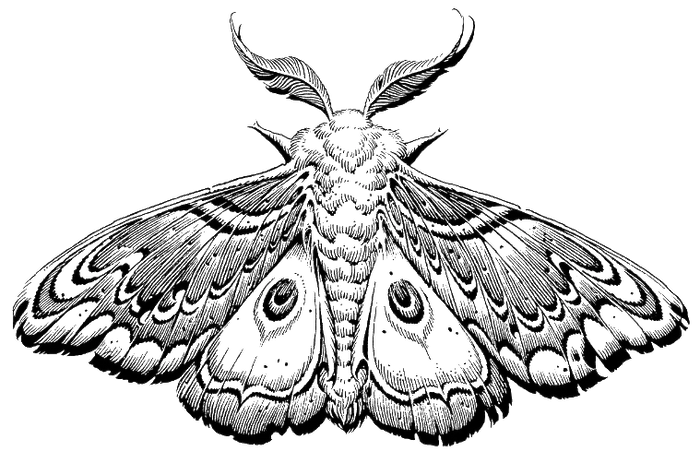
A sister to the Mother of Pearl version which came before it, these moths feature ornate antennae and long tails that wrap around the ring band, guarding a "Dark Moon" Black Mother of Pearl cabochon.
Eclipse is a word used for a grouping of moths, due to how they "eclipse" light sources they cluster around, as they are nocturnal and are drawn to light. As an ancient species, moths used the moon and stars as a source of navigation ( called transverse orientation ) to fly straight, similar to how early humans used the North Star before navigational tools were invented. As artificial light has permeated every aspect of modern living for many if not most parts of the world, moths flight patterns have changed, with some exhibiting disorienting spiral flight patterns.
Truly a talisman of the night and how certain people, flora, and creatures are more attuned and comfortable with it, this jewel contains the symbology of the Moon, Datura, & the Moth. Highly tactile, this ring is meant to be a comfort on multiple levels: the textures of both moths, the smooth surface of the Black Mother of Pearl, as well as the potential companionship for all of your Nighttime journeys as you bloom in the dark.
Datura Moths:
Datura stramonium ( with a species of 9-14 ), also known as Jimson weed, Thorn apple and Devil’s Trumpet, is a flowering plant that originated in the Americas and spread across the seas. Much like other members of the solanaceae family, it is highly toxic in high doses. This includes all parts of it, from its gorgeous trumpet like flowers, to its toothy leaves, its roots and its infamous inky black seeds which are incased in spiky seed pods. In smaller doses, it has been used in the past as healing salves for inflammation and pain while also being utilized in folk magic to induce visionary and hallucinogenic states. Among tribes with shamanic practices, Datura was considered sacred and can be found in cave paintings and on pre-historic ceramics, suggesting its use during these times.
One of the attributes of this plant that drew me to it aside from its beauty and folklore, is its ability to grow alongside the edges of places, even here in the city. Its seeds disperse when its pods dry and crack open and I’ve witnessed it grow from cracks in the sidewalk, through holes in chain link fences, abundantly in between buildings and in other abandoned empty spaces in the city where such beauty seems out of place. It is seemingly weed like in nature and yet in other places, it is planted with care as an ornamental despite its poisonous properties.
I’ve been amazed at the thick roots of one bush that grew wild in an abandoned space between two buildings before it was cut down, its seeds freckling the earth as if to say, you haven’t truly destroyed me. Its hardiness in the face of a gritty landscape and Phoenix like regenerative qualities endears me to it as much as its beauty and magical properties.
Moon colored, Datura unfurl and open at night and is therefore pollinated by moths, Sphinx moths in particular who hover around its blooms like hummingbirds, sipping from them with their long tongues. I witnessed this for the first time last summer, while visiting one plant with a friend from out of town near where I live in a fairly industrial part of the city. We watched the moth drink from flower to flower in wonder in the hot summer night air until it moved on. It felt both strange and wonderful to witness and I don’t know why it surprised me to see; if there are flowers thriving in the city, surely there could be Sphinx moths ?
This fortuitous moment inspired the jewel on offer here : a hybrid creature, a moth that is a Datura, a Datura that is a moth. Its sinuous body is meant to evoke the rippling petals of the Datura flower in bloom while also retaining the gesture and features of a moth, albeit one born from dreams rather than natural history.
Moths have long been a creature I’ve used in the library of my personal symbology within Blood Milk. As a symbol of transformation: beginning their lives as caterpillars, they gorge themselves before outgrowing their exoskeletons. They will sometimes shed their skins ( like a snake ! ) up to five times with their final time forming its chrysalis or pupa. This is the fascinating / magical part for me: their caterpillar bodies will begin to disintegrate into a kind of jelly yet its believed they retain some of their memories as their new body moth body forms in the velvety dark protection of its cocoon. Once its ready to emerge, it begins to break free and its struggle to release itself also helps pump fluid and energy into its wings. Moth signifies, a period of patience, surrender and profound transformation or awakening through introspection. Just like Datura, Moth is linked to the Unseen world and many feel that moths are messengers from the spirit world, bringing signs from their beloved dead to them.